WAS FOUNDED IN 1855
WAS FOUNDED IN 1855
Boris Sreznevsky
(March 19 (31), 1857, St. Petersburg - March 24, 1934, Kyiv) - Russian and Ukrainian meteorologist and climatologist, professor, full member of the Ukrainian SSR Academy of Sciences (since April 19, 1920), 1920), organizer of the meteorological service in Ukraine, director of the Kyiv Meteorological Observatory (1919-1934), founder of the Geophysical Commission (later the Department of Geophysics) of the Ukrainian SSR, the Department of Agricultural Metrology at the People's Commissariat of Education of the Ukrainian SSR, and a number of periodicals of Ukrainian meteorological scientific publications.
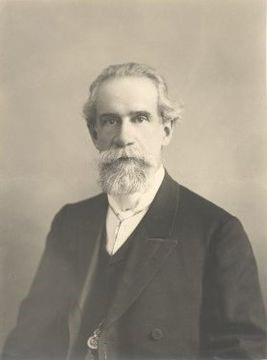 Biography.
Boris was born on March 31, 1857 in St. Petersburg in the family of philologist and Slavicist Izmail Sreznevsky. Out of eight children, only Boris chose the natural sciences as his field of study, while the rest contributed to the world's cultural treasury as humanities scholars. In 1879, he graduated from the Faculty of Physics and Mathematics of St. Petersburg University and chose meteorology and climatology.
Academician Borys Izmailovych Sreznevskyi's scientific and pedagogical experience spans over 54 years: teaching meteorology and general physics at Moscow (1892-1893), St. Petersburg (1888-1891) and Voronezh Universities; 10 years of scientific work at the Main Physical Observatory (Main Geophysical Observatory named after A. I. Voyeikov, St. Petersburg, Russia); 25 years (1894-1918) at the University of Derpta (Estonia), from 1899 he was the Dean of the Faculty of Physics and Mathematics; one year at the Kyiv Polytechnic Institute and 14 years at the Kyiv Institute of Public Education (now Taras Shevchenko National University of Kyiv).
In 1890, he participated in the founding of the Meteorological Bulletin at the Russian Geographical Society, and from 1899 he was the editor of the journal. At the same time, from 1900 he headed the Baltic Meteorological Service. Sreznevsky published Meteorological Observations on a monthly basis, first in Moscow, then in Yuriev. From 1919 until the end of his life, he headed the Meteorological Observatory at Kyiv University. He lectured on meteorology and geophysics at the Kyiv Institute of Public Education. At the same time, he was elected an academician of the Department of Applied Physics II (Natural Sciences) of the Ukrainian Academy of Sciences.
Academician B.I. Sreznevsky was one of the active founders of the Ukrainian Meteorological Service (UkrMet) and the first scientific director of the Weather Service. Sreznevsky was a prominent organizer of the meteorological service in Ukraine; in 1920, he organized evaporometric and resumed balloon-pilot (including baseline) observations. In 1922, he began work on solar radiation measurements, later on atmospheric optics, and in 1928 - on atmospheric electricity. He has been a scientific director of the Weather Bureau since 1921. In 1926, he organized a research department of geophysics and agricultural meteorology at the Ukrainian National Academy of Sciences. Young people and supporters of his scientific views constantly gathered around the scientist. He introduced the use of the frontological method in the operational work of Ukrmet. He made a significant contribution to the study of synoptic and agrometeorology, evaporation theory, and hydrography. He developed the theory of aridity signs, as well as one of the first schemes of climatological zoning in Ukraine. He studied the distribution of pressure over the European part of Russia, the paths of cyclones, blizzards, and the impact of weather on humans. He was the inventor of meteorological and geophysical instruments: a psychrometer-sling, plate evaporators, radio integrators, an evaporation booth, a lightweight evaporator, a total rain gauge, a gypsum ruler, stereo photogrammetry, and others. Boris Izmailovich's name is on the list of 107 founders and luminaries of Russian meteorology.
In just 4 years (1920-1923) at the Ukrainian Academy of Sciences, he made 32 scientific reports at the meetings of the II Natural Department.
After the establishment of the Hydrometeorological Institute in 1931, B.I. Sreznevsky was both the head of the Institute's General Meteorology Section and the head of the Observatory.
Academician B.I. Sreznevsky's main research interests were droughts and heavy rains, especially important for the southeast of Ukraine. Based on the processing of long-term meteorological data from the Prydniprovia grid of stations for Kyiv, he developed a theory of "drought signs".
In his memoirs, Borys Izmailovych wrote that these achievements forced UkrScience to break the framework of the university observatory and give it independence, so later it was called the Magnetic and Meteorological Observatory, then the Geophysical Observatory (only in 1996 did it manage to restore this name). The Observatory operated the first radiological laboratory in Ukraine, conducted electrometeorological measurements, studied the upper atmosphere, and prepared to determine the elements of earth magnetism.
The destruction of the bridge over the Prypiat River in the summer of 1929 attracted the scientist's attention, and on behalf of the People's Commissariat of Railways and Labor Inspection, Borys Izmailovych developed the issue of the occurrence and prediction of hurricanes and tornadoes in Ukraine.
In the 1930s, he wrote an important work on the water balance of the Donbas, in particular on evaporation from enclosed reservoirs. The scientist studied this issue in detail and in depth, created a map of natural evaporation in the European part of the former Soviet Union and compiled a report of evaporation observations.
In addition to his editorial duties in various journals and positions as chairman of various societies, B.I. Sreznevsky gave reports on the life and work of Behr, Helmholtz, Gogol, Pushkin, Zhukovsky, Verdi, and Grieg, and on the causes and consequences of local malaria. In Kyiv, the scientist tried to introduce medical meteorology into the circle of interests of the Red Cross. That is, Academician B.I. Sreznevsky was competent in various fields of knowledge.
At the Kyiv Observatory B. Sreznevsky gathered a team of young scientists and created a scientific school of Kyiv meteorologists headed by Ivan Kyrylovych Polovko. His student, the longtime dean of the Geography Faculty of Kyiv University, Mykhailo Ilyich Shcherban, continued the best traditions of the Kyiv University Meteorological Observatory in his scientific and pedagogical work.
B.I. Sreznevsky had three children. Serhii, who served in the navy, emigrated and was allegedly seen in Ethiopia. The fate of his brother Volodymyr and sister Kateryna has not yet been established.
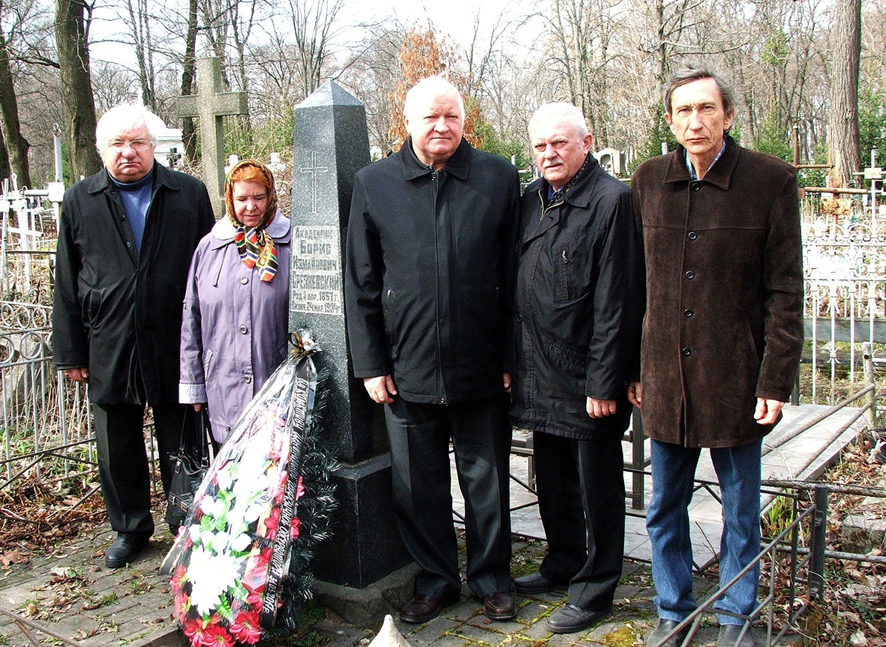
He died on March 24, 1934. He was buried in Kyiv, in the 17th section of the Lukianivske cemetery. His grave has been under state protection since 2005. The staff of the Hydrometeorological Service helps to maintain it.
In the photo below, employees of the Borys Sreznevsky Public Organization honor the great scientist at his grave on the day of his 160th birthday (31.03.2017).